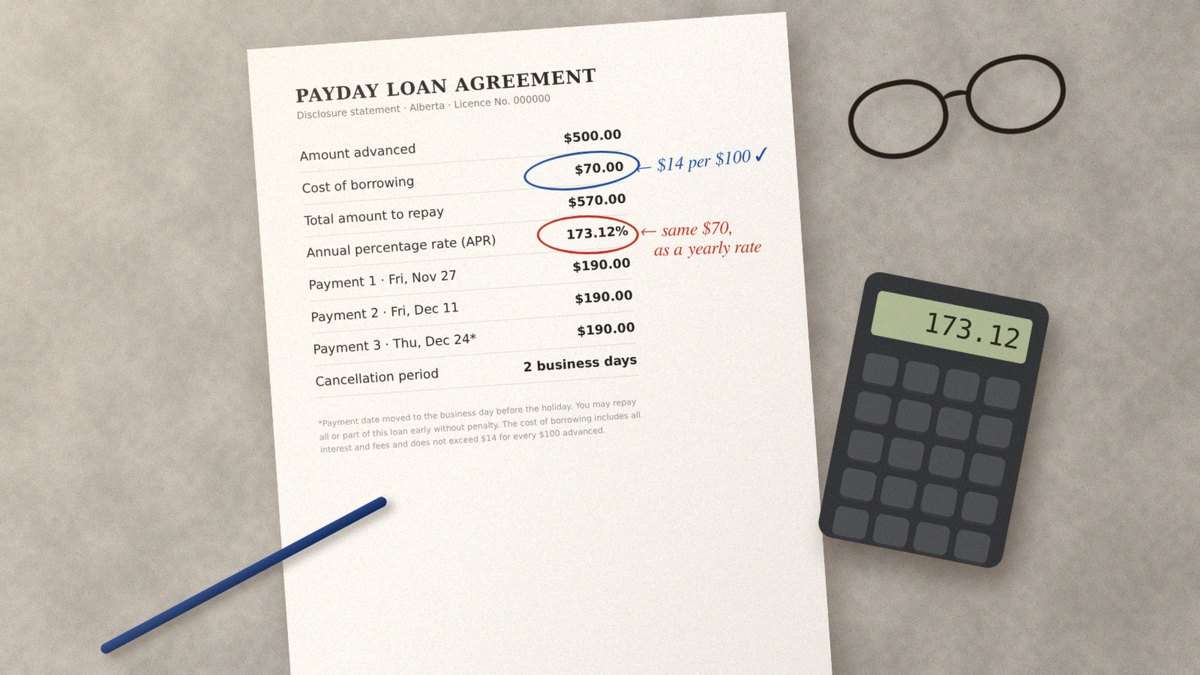
An Edmonton reader sent us a question that comes up a lot. She’d borrowed $500, and her agreement said the cost was $70. A few lines down, the same agreement listed an annual percentage rate of about 173%. “Which one is real? Am I paying 14% or 173%?”
Both numbers are accurate. They measure different things, and once you know how they relate, you can read any payday loan agreement in Canada quickly and see whether an offer is fair, legal and worth taking. This guide explains the dollar cost, the APR, why payday loans are allowed to go above Canada’s 35% criminal interest rate, and the charges that aren’t included in either number.
The Short Answer: What a Payday Loan Costs in Canada
Since January 1, 2025, a licensed payday lender can charge no more than $14 for every $100 you borrow. That cap covers everything: interest, fees, setup charges and any other cost of borrowing. Borrow $500 and the most you can be charged is $70, so you repay $570 in total.
The cap applies to loans of $1,500 or less, repaid within 62 days, from a lender licensed in a province that regulates payday lending. Our guide to payday loan laws in Canada covers the federal and provincial rules in full, and our main payday loans page covers eligibility and the application.
Why the Same $70 Can Be 82%, 173% or 365% APR
APR is the cost of borrowing stated as a yearly rate. It’s useful because it puts very different kinds of credit on the same scale. But a payday loan only lasts a few weeks, so turning its cost into a yearly figure produces a big number. And because the APR depends on how long you have the money, the same $70 gives a different APR depending on how you repay.
| Same $500 loan, $70 cost | How you repay | Approximate APR |
|---|---|---|
| Single payment after 14 days | $570 on your next payday | About 365% |
| Alberta-style, 3 instalments over 42 days | $190 every two weeks | About 173% |
| Single payment after 62 days | $570 at the end of the maximum term | About 82% |
The dollar cost is identical in all three rows. The APR falls as the time you keep the money gets longer. That’s why Alberta’s instalment rules, which spread every payday loan over at least 42 days at no extra cost, show a lower APR than the classic two-week loan.
The useful takeaway: when you compare payday loans with each other, compare dollars. When you compare a payday loan with other kinds of credit, look at the APR.
Why Payday Loans Are Legal Above the 35% Criminal Rate
The Criminal Code makes it a crime to lend at more than 35% APR. Payday loans are well above that, so how are they legal? Section 347.1 of the Code creates an exemption. A payday loan isn’t covered by the criminal rate if all of these are true:
- The loan is $1,500 or less
- It’s repaid within 62 days
- The lender is licensed in a province that has its own payday loan law and cost limit
- The cost stays within the federal maximum of $14 per $100
Step outside any of those and the protection is gone. That’s why a “payday loan” of $3,000, or one lasting four months, is either a different product with its own rules or an illegal loan. It’s also why Quebec and the territories, which don’t license payday lenders, have no legal payday loans at all.
What $500 for Two Weeks Costs With Other Credit
This is where the APR earns its place. Put next to everyday borrowing options, the gap becomes obvious:
| $500 for about two weeks | Typical cost | What you need |
|---|---|---|
| Payday loan (maximum) | $70 | Steady income and a bank account |
| Credit card cash advance | About $5 to $15 (interest from day one plus a fee) | Available credit on a card |
| Overdraft protection | About $5 to $10 (interest plus a monthly fee) | Overdraft set up on your account |
| Employer pay advance | Often $0 | An employer that offers one |
| Credit union small loan | A few dollars of interest | Membership and approval, which takes time |
A payday loan is usually the most expensive option on this list, by a wide margin. People use it because the cheaper options are often unavailable when they need them: the card is maxed out, there’s no overdraft, or the bill is due tomorrow. If one of the cheaper options is open to you, use it first. Our list of payday loan alternatives covers more options.
An Edmonton Example: Reading the Numbers on Your Agreement
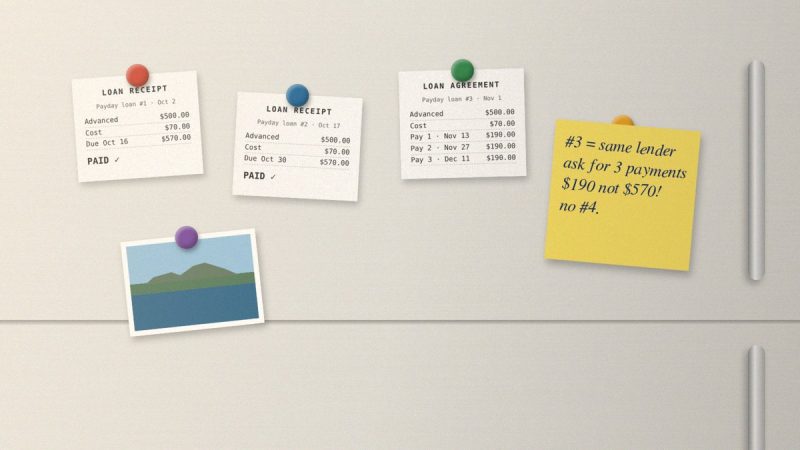
Back to our reader. She works in a warehouse in northeast Edmonton and is paid every second Friday. She borrowed $500 to cover a car repair. Under Alberta’s payday loan rules, the loan had to be spread over at least three pay periods, so her agreement looked like this:
| Line on the agreement | What it said | What to check |
|---|---|---|
| Amount advanced | $500.00 | Matches what you asked for and what arrives in your account |
| Cost of borrowing | $70.00 | No more than $14 per $100 |
| Total to repay | $570.00 | Amount plus cost, nothing else added |
| Annual percentage rate | About 173% | Present and clearly labelled |
| Payments | 3 × $190, every second Friday | Each date falls on or after a payday |
| Cancellation | 2 business days, no cost | You know the deadline |
| Licence | Service Alberta licence number | Look it up before you sign |
Everything checked out. The cost was within the cap, the three payments landed on her paydays, and the lender was licensed with Service Alberta. Her one regret was that she hadn’t asked her employer about a pay advance first, which she found out afterwards was available.
If you’re in the capital region, our page on Edmonton payday loans covers local options and how e-Transfer funding works there. Our earlier guide, Need Money Before Payday in Edmonton?, walks through Alberta instalments in more detail.
Costs That Aren’t in the $14
The $14 cap covers the cost of borrowing when everything goes to plan. If a payment bounces, more charges can apply:
- A returned-payment fee from the lender, limited by your province’s rules
- Default interest on the overdue amount; in Alberta that’s up to 2.5% a month
- Your bank’s NSF fee, which is separate and often higher than the lender’s fee
These charges are why matching each payment to your payday matters more than a few dollars of difference between lenders. If you’re worried about missing an instalment, our guide to what happens if you can’t repay a payday loan in Alberta explains your options.
How to Compare Payday Loan Offers in 60 Seconds
- Look at the total to repay, in dollars. If it’s more than $114 for every $100 borrowed, the lender is breaking the law.
- Look for extras. “Express funding,” “membership” or “processing” fees all count toward the $14 cap. If the lender charges them on top, walk away.
- Check the APR is shown. A licensed lender’s agreement must disclose it. A missing APR is a warning sign.
- Match the dates to your pay. A payment that lands the day before your deposit can cost more in NSF fees than you’d save by picking a cheaper lender.
- Confirm the licence. Every province that allows payday loans keeps a public list of licensed lenders.
Lenders that offer insurance or other add-ons with a payday loan deserve extra caution. In several provinces, including BC, lenders aren’t allowed to sell them at all.
Frequently Asked Questions
Is $14 per $100 the interest rate on a payday loan?
Not exactly. It’s the maximum total cost of borrowing, including interest and all fees, for the whole loan. Turned into a yearly rate, a $14 charge on a two-week loan works out to about 365% APR.
What APR is a payday loan in Alberta?
It depends on the schedule. An Alberta payday loan repaid in three equal instalments over 42 days at the maximum cost works out to roughly 170% APR. Your agreement shows the exact figure.
Why is a payday loan legal if the criminal interest rate is 35%?
Section 347.1 of the Criminal Code exempts payday loans of $1,500 or less, repaid within 62 days, from lenders licensed in a province with its own payday loan law. Loans outside those limits don’t get the exemption.
Can a payday lender charge fees on top of $14 per $100?
Not for the loan itself. The $14 limit includes every fee and charge. The only extra charges allowed are for things like a returned payment or default interest on an overdue amount, as set by your province.
Does a longer payday loan cost more in Alberta?
No. Alberta lenders can’t charge more because your loan is spread over a longer period. A 42-day instalment loan and a 62-day loan both cost at most $14 per $100.
Is the APR or the dollar cost more important?
Use the dollar cost to compare payday loans with each other, because they all run for a few weeks. Use the APR to compare a payday loan with longer-term credit such as a credit card or personal loan.
This article is general information, not legal or financial advice. Reviewed against the Criminal Code’s payday loan exemption (section 347.1), the federal cost limit in force since January 2025, and Alberta’s payday loan rules in November 2026. The APRs above are estimates. Your agreement shows the exact figure.