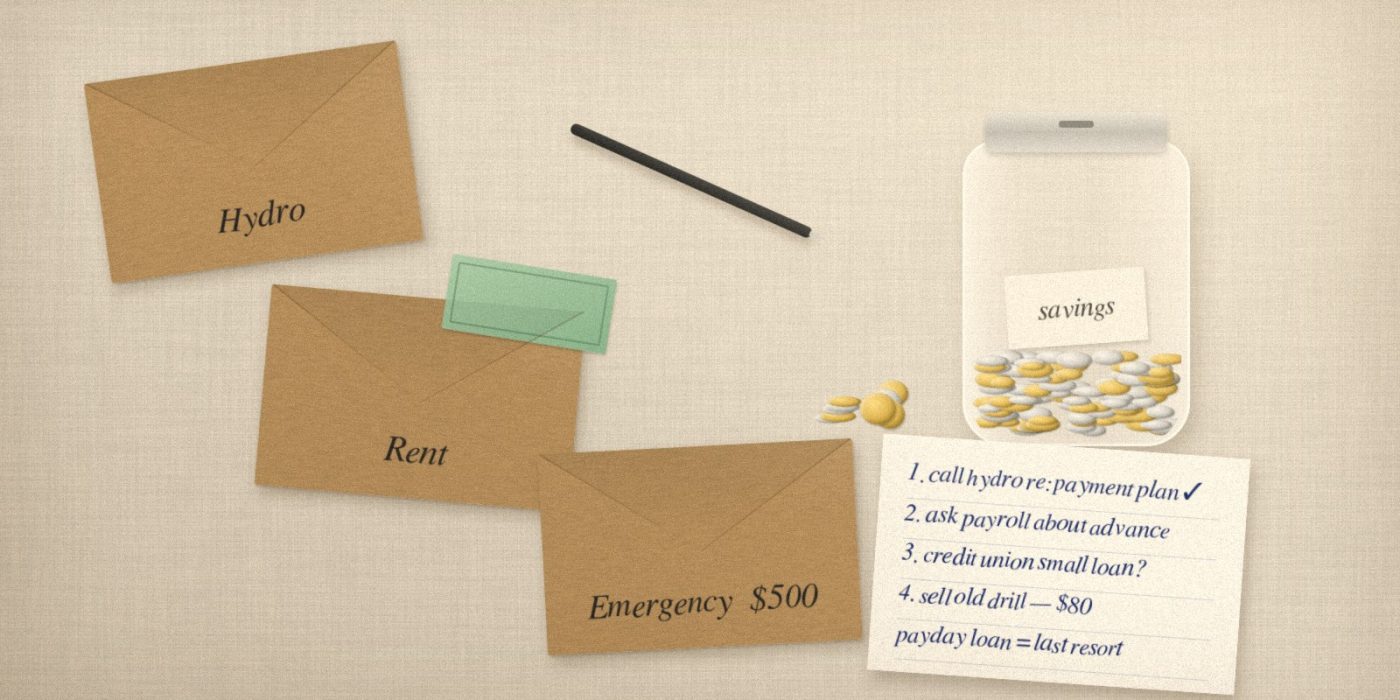
Most people who end up with a payday loan didn’t plan to. A bill arrives early, a paycheque arrives late, and the gap is a few hundred dollars. Payday loans are fast and easy to get, which is exactly why it’s worth pausing for ten minutes before you apply. Several cheaper options can often close the same gap, and some cost nothing at all.
Below are seven payday loan alternatives in Canada, roughly in order of cost, with what each one is good for and where it falls short. At the end, we’ll cover the situations where a payday loan can still be the reasonable choice, because sometimes it is.
Who’s writing this: CCFD is a free payday loan referral and financial-information service. We’re not a lender, and we’d rather you use one of these options if it fits. If none does, we explain how to borrow safely.
What each option really costs
Here’s a rough comparison for covering a $400 shortfall for three weeks. Your own rates will differ, so treat these as ballpark figures:
| Option | Typical cost for $400 over 3 weeks | Repayment |
|---|---|---|
| Payment plan with the biller | Often $0 | Split over your next bills |
| Employer pay advance | Often $0 | Taken from your next paycheque |
| Family or friend loan | $0, if agreed | On the date you agree |
| Credit card cash advance (about 22% a year) | About $5, plus an advance fee | Over time, at your card’s rate |
| Credit union small loan | Usually a few dollars to about $20 | Over several weeks or months |
| Payday loan at $14 per $100 | Up to $56 | Usually your next payday |
The gap is the whole point: the same $400 can cost nothing, or more than $50. That difference grows quickly if you borrow more than once.
1. Ask the company you owe for a payment plan
If the problem is a bill rather than a purchase, call before the due date. Utilities, phone and internet providers, insurers, dental offices and many landlords have payment arrangements or hardship programs that they don’t advertise. Most would rather split a bill than send it to collections.
Keep the call simple: tell them when you get paid, what you can pay today, and when you can pay the rest. Write down the name of the person you spoke to and what you agreed.
Works best for: hydro, gas, phone, internet, insurance premiums and medical or dental bills. The catch: it only helps if you call before the account falls too far behind.
2. Ask for an advance on pay you’ve already earned
An advance on wages you’ve already worked isn’t a new loan; it’s early access to your own money. Ask your manager, payroll or HR whether they offer it. Hospitals, universities, governments and other large employers are the most likely to have a formal process.
Some workplaces also offer “earned wage access” through an app. Read the fee carefully: some charge a flat fee per advance or ask for a “tip”, and a small fee on a small advance can still be expensive in percentage terms.
Works best for: a small, one-time gap when you have steady hours. The catch: your next paycheque will be smaller by the same amount, so plan for that week too.
3. Talk to a credit union or your bank
Credit unions often offer small personal loans, overdraft protection or lines of credit to members, sometimes with more flexible terms than a big bank. A few have built products specifically as payday loan alternatives; in British Columbia, for example, Vancity offers a small-dollar “Fair & Fast” loan.
If you already bank somewhere, ask what’s available for a few hundred dollars, and whether an overdraft or a credit card cash advance would be cheaper for a few weeks. Cash advances usually start charging interest right away and often add a fee, but the total is typically still far below a payday loan.
Works best for: anyone who needs a few weeks or months to repay. The catch: approval and setup can take a few days, so ask before you’re in a crisis if you can.
4. Sell, return or pause something
If you can wait a day or two, selling something you don’t use can raise a few hundred dollars with no repayment at all. Tools, electronics, furniture, sports gear, baby items and unused gift cards tend to move quickly on local marketplaces. Check whether a recent purchase can still be returned.
Pausing subscriptions helps too. Streaming services, meal kits, app subscriptions and delivery memberships can usually be paused or cancelled for a month without penalty.
Works best for: expenses that can wait 48 hours. The catch: meet buyers in a public place, and never accept overpayments or “send back the difference” requests; that’s a common scam.
5. Claim the benefits and help you’re entitled to
If the shortfall comes from a job loss, cut hours, illness or a family emergency, there may be help you haven’t claimed:
- Employment Insurance: apply as soon as your work ends; waiting can delay your first payment.
- Federal credits and benefits: the Canada Child Benefit and the GST/HST credit are paid automatically when you file your taxes, so filing on time matters even with little income.
- Provincial emergency assistance: most provinces offer one-time help for urgent needs such as rent, utilities or food to people with no other options.
- Rent banks and utility assistance: many cities run rent banks, and provinces offer programs for overdue energy bills.
- 2-1-1: dial 2-1-1 or visit 211.ca to find local food banks, housing help and financial programs anywhere in Canada.
Works best for: income interruptions and essentials like housing, heat and food. The catch: applications take time, so start the same day you need help.
6. Borrow from family or friends, in writing
Borrowing from someone you trust can be the cheapest option, but only if both of you treat it like a real loan. Agree on the amount, the date and how you’ll repay it, and write it down, even in a text message: “I’ll send you $300 by e-Transfer on November 27, after payday.”
Works best for: small amounts, when the other person can genuinely afford to wait. The catch: a missed repayment can cost more than money, so only promise a date you can keep.
7. If you do borrow, compare the full cost first
Sometimes none of the above works in time, and a payday loan is the practical answer. If so, compare the total repayment, not just the amount you receive. In the nine provinces that license payday lending, the cost is capped at $14 per $100 borrowed, including every fee. A $400 loan costs up to $56; a $500 loan costs up to $70.
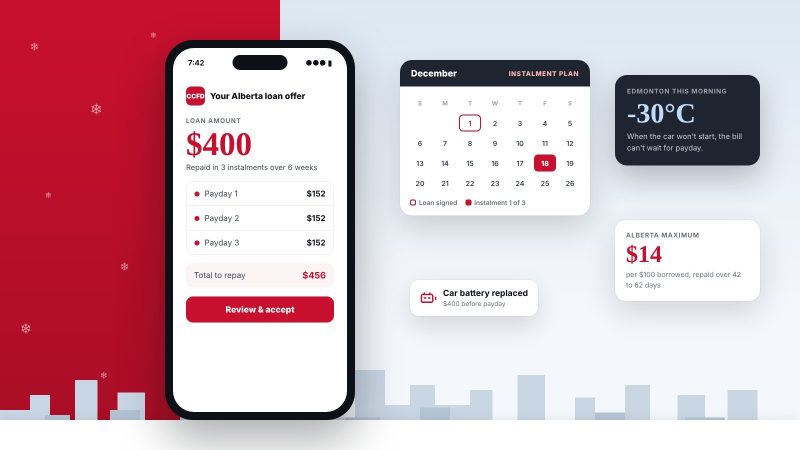
Rules also differ by province. In Alberta, for example, payday loans are repaid in instalments over 42 to 62 days, while in Ontario and British Columbia a loan can’t exceed half your net pay. Read the payday loan laws in Canada or the guide for your province before you sign. Payday loans aren’t available from licensed lenders in Quebec or the territories.
When a payday loan can still make sense
A payday loan can be a reasonable choice when all of these are true:
- The expense is urgent and can’t be delayed or split.
- You know exactly which paycheque will repay it.
- After repaying, you’ll still cover rent, food and transportation.
- You’ve already checked the cheaper options above.
- You’ve read the total cost, the due date and your cancellation right in the agreement.
If you decide to go ahead, CCFD can pass your free online application to a lender licensed in your province. Many lenders consider applicants with bad credit (see how credit checks work), and approved funds are usually sent by Interac e-Transfer. CCFD doesn’t make credit decisions, and approval is never guaranteed.
Red flags to walk away from
- A promise of guaranteed approval before anyone has looked at your information.
- Any fee, gift card or e-Transfer requested before you get the money.
- Pressure to sign right now, or an offer that doesn’t show the total cost in dollars.
- No licence number for your province on the website or agreement.
- A suggestion to take a new loan to pay off the old one.
These are the hallmarks of scams and unlicensed lenders. Our page on responsible borrowing lists more warning signs and where to get free help.
How to need a payday loan less often
If short-term gaps happen every month, the loan isn’t the real problem; the budget is. A few small habits make a real difference over a few months:
- Track one month of spending to see where money actually goes.
- Move $10 to $25 into savings on every payday, automatically, until you reach a $500 cushion.
- Keep a bill calendar so due dates line up with paydays, and ask billers to move dates that don’t.
- Save a list of local help, such as your rent bank and utility programs, before you need it.
Our financial education guide covers building an emergency fund and budgeting around irregular pay in more detail. If several debts are already behind, a free non-profit credit counsellor can help you build a plan.
Frequently asked questions
What is the cheapest alternative to a payday loan?
Usually a payment plan with the company you owe or an advance on wages you’ve already earned. Both often cost nothing.
Can I get emergency money in Canada without a payday loan?
Often, yes. Depending on your situation, Employment Insurance, provincial emergency assistance, rent banks, utility programs, food banks or a credit union loan may help. Dial 2-1-1 to find local services.
Is a credit card cash advance cheaper than a payday loan?
Usually, yes. Interest starts right away and there’s often an advance fee, but for a few weeks the total is typically a fraction of a payday loan’s $14 per $100.
Are payday loans ever a good idea?
They can be a reasonable last resort for a genuine one-time emergency you can repay on time. They’re not suited to recurring bills or ongoing shortfalls.
Does CCFD guarantee loan approval?
No. CCFD is a free referral service. It connects applicants with lenders licensed in their province, and the lender makes the decision and sets the terms.
This article is general information, not financial advice. Reviewed against Financial Consumer Agency of Canada guidance and provincial payday loan rules in November 2026.