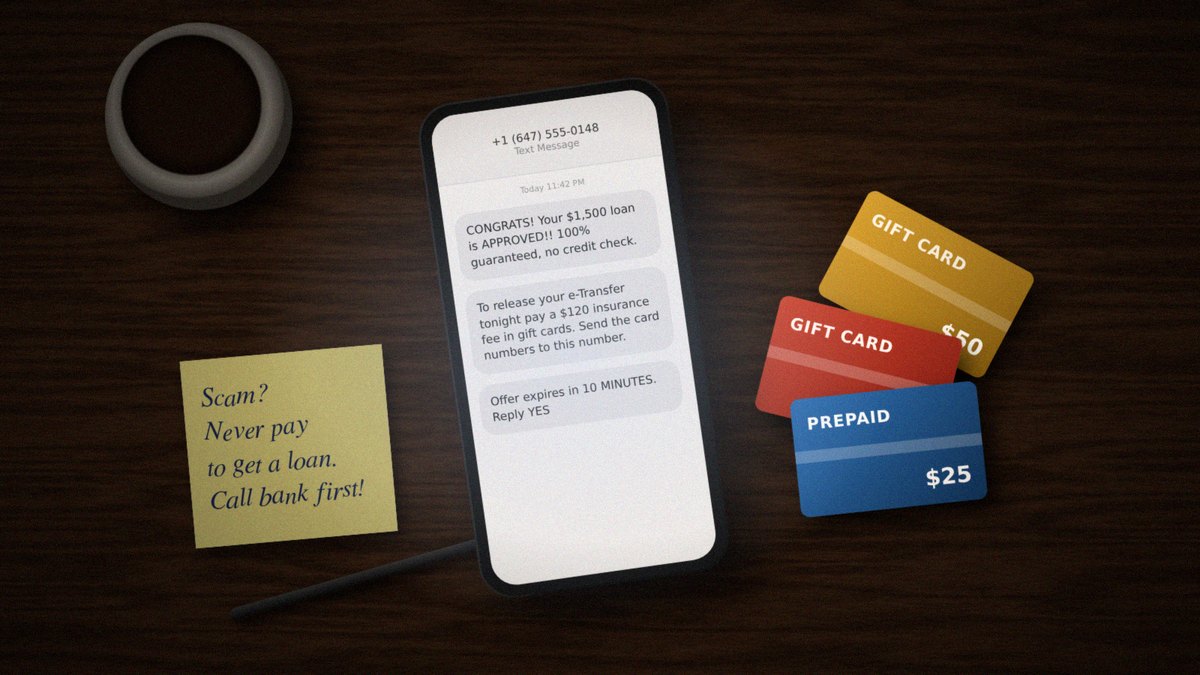
The text usually arrives at a bad moment. Rent is due Friday, the account is at $40, and your phone lights up: “Congratulations, your $1,500 loan is APPROVED. To release your e-Transfer today, pay a $120 insurance fee.” It’s tempting to read that as good news. It’s actually the clearest sign of a scam there is.
Fake lenders target people who need money fast because urgency gets in the way of careful thinking. The good news is that most loan scams follow the same script, and once you know it, they’re easy to spot. This guide covers the nine warning signs we see most often, how to check that a lender is licensed in your province, and what to do today if you’ve already paid or shared your details.
The One Rule That Catches Most Loan Scams
With a real loan, money comes to you first. You never pay to get it. A licensed payday lender sends the funds, then collects the repayment on the date set out in your written agreement. Its fees are part of what you repay. They are never a separate charge you pay before the money arrives.
So if anyone asks you to send money before you’re funded, stop. It doesn’t matter if they call it an insurance fee, a security deposit, a “first payment”, a processing charge or a way to prove your credit. Each of these is the same trick under a different name. Our responsible lending standards say the same thing plainly: never pay an upfront fee to get a loan.
How a Fake Loan Offer Usually Plays Out
Scams vary in the details, but most follow the same five steps. If you recognize the pattern partway through, you can get out before you lose anything.
- The hook. You get an ad, a text, a social media message or a search result promising “guaranteed approval” or “no refusal.” Sometimes it reaches you right after you’ve applied somewhere real, which makes it more convincing.
- The quick “approval.” Within minutes you’re told you’re approved, often for more than you asked for. Nobody has looked at your income or your bank account.
- The catch. A fee has to be paid before the money is released. You’re told to pay by gift card, cryptocurrency, an e-Transfer to a personal email address, or a wire transfer.
- The squeeze. Once you pay, a new problem comes up: a “failed transfer,” a “tax hold,” or a bigger amount you now “qualify” for. Each one comes with another fee.
- The silence. The phone number stops working, the website disappears, and no loan ever arrives.
Step three is where the scam shows itself. Everything before it can look professional. Asking you to pay first is the one thing a real lender never does.
9 Warning Signs of a Payday Loan Scam
1. You’re asked to pay before you get the money
This is the big one. Licensed lenders take their fees out of what you repay, according to your agreement. Any request to pay first, for any reason, means you should walk away.
2. Approval is “guaranteed”
Real lenders turn people down. They have to check your income, your banking history and the rules in your province before they offer anything. A promise of “100% approval” before anyone has looked at your information isn’t a lending decision. It’s a sales pitch. CCFD doesn’t make credit decisions or promise approval, and you should be wary of anyone who does. Our page on what “no refusal” loans really mean explains why.
3. They want gift cards, crypto or an e-Transfer to a person
Scammers choose payment methods that are hard to trace and nearly impossible to reverse. Once a gift card number or a crypto transfer is gone, it rarely comes back. No licensed lender in Canada collects money this way.
4. Someone asks for your banking password or a one-time code
A real lender may ask to verify your bank account (more on that below). But no lender, and no one from your bank, will ever ask you to read out your password, your PIN or a code that was just texted to you. That code is exactly what someone needs to get into your account.
5. The pressure is built in
“This offer expires in 10 minutes.” “Pay now or lose your approval.” Deadlines like these are there to stop you checking anything. A legitimate lender gives you the agreement to read and leaves the decision to you. In most provinces you can even cancel a payday loan within a day or two after signing.
6. The numbers don’t make sense for a payday loan
Payday loans in Canada are small and short. Under federal rules they’re capped at $1,500, must be repaid within 62 days, and can cost no more than $14 for every $100 borrowed. An offer of $5,000 with “no payments until next year,” or a fee well above $14 per $100, isn’t a payday loan from a licensed lender. Our payday loans guide explains what a normal loan looks like.
7. They contacted you first
An unexpected call, text or direct message saying you’re “pre-approved” should make you suspicious, especially if it uses the name and logo of a company you’ve heard of. Copying a real brand is easy. Don’t use the link or number in the message. Look up the company yourself and contact it directly.
8. No licence, no address, no written agreement
Before you apply, check who actually runs the website. A real lender lists its legal business name, a physical address, a working phone number, a privacy policy and its provincial licence. Before you sign, it gives you a written agreement showing the amount, the total cost, the due date and any fees for missed payments. If any of that is missing or vague, or if the terms change after you apply, don’t go ahead.
9. They want documents they don’t need yet
Be careful if a site asks for a photo of your passport, a selfie holding your driver’s licence, or your Social Insurance Number before you’ve seen a real offer. Scammers use these to steal identities, and that damage can last much longer than any loan. In Canada, your SIN is not required to apply for credit. A lender may ask for it, but you can usually decline.
Real Lender or Scam? A Side-by-Side Check
| What happens | Licensed lender | Likely scam |
|---|---|---|
| When you pay | After you receive the loan, on the due date in your agreement | Before you get anything, as a “fee” or “deposit” |
| How you pay | Pre-authorized debit or the method in your contract | Gift cards, crypto, wire, or an e-Transfer to a personal email |
| Approval | Depends on your income and banking; some people are declined | Guaranteed, instant, often for more than you asked |
| Cost | Up to $14 per $100 borrowed, shown in writing | Vague, or new fees keep appearing |
| Bank access | Read-only verification through a secure service | Asks for your password, PIN or texted code |
| Paperwork | Written agreement, licence number, cancellation rights | Chat messages only, no contract |
| Contact | You apply through their site | They message you out of nowhere |
Bank Verification: What’s Normal and What Isn’t
This is where many people get confused, because real lenders do look at your bank account. Most online lenders use a secure, read-only verification service. You pick your bank from a list and sign in on a screen that connects directly to the bank. The lender gets a view of your recent deposits and balance. It can’t move money, and it never sees your password.
Here’s what is not normal:
- Someone on the phone or in a chat asking you to read out your banking password
- A request to type your login details into an email, a text message or a regular web form
- Being asked for the one-time security code your bank just sent you
- Instructions to install a “screen sharing” or remote access app so they can “help” with your application
If you’re not sure which one you’re dealing with, close the window and call the number on the back of your bank card. Your bank would much rather get that call than help you recover from fraud afterwards.
Check the Licence in Your Province
Payday lending is regulated by each province, and in the provinces that license payday lenders, any lender serving you, including online lenders, needs a licence where you live. Checking only takes a few minutes. Search the regulator’s website for the lender’s legal name, not just the brand name on its ads.
| Province | Who licenses payday lenders | Our province guide |
|---|---|---|
| Alberta | Service Alberta | Alberta rules |
| British Columbia | Consumer Protection BC | BC rules |
| Ontario | Government of Ontario (search via Consumer Protection Ontario) | Ontario rules |
| Saskatchewan | Financial and Consumer Affairs Authority (FCAA) | Saskatchewan rules |
| Manitoba | Manitoba Consumer Protection Office | Manitoba rules |
| New Brunswick | Financial and Consumer Services Commission (FCNB) | New Brunswick rules |
| Nova Scotia | Service Nova Scotia | Nova Scotia rules |
| Newfoundland and Labrador | Digital Government and Service NL | NL rules |
| Prince Edward Island | PEI Consumer, Labour and Financial Services | PEI rules |
There’s one more thing to know if you live in Quebec, Yukon, the Northwest Territories or Nunavut. Licensed payday lenders don’t operate there, so a website offering you a payday loan in those places is a serious red flag. Our Quebec guide explains why and lists safer options.
Already Sent Money or Shared Your Details? Do This Today
Don’t be embarrassed. These scams are designed by people who do this full time, and they catch careful people too. The faster you act, the more you can protect.
- Call your bank or card issuer right away. Ask whether the payment can be stopped or reversed. If you sent an Interac e-Transfer that hasn’t been deposited yet, you may still be able to cancel it in your banking app.
- Change your passwords. If you shared your banking login or a security code, change the password and turn on two-step verification. Tell your bank so it can watch for unusual activity.
- Stop all contact. Don’t send more money, even if they promise it’s the last fee. Paying again never gets you the loan.
- Save the evidence. Take screenshots of the website, the messages, the phone numbers and any payment receipts.
- Report it. Contact the Canadian Anti-Fraud Centre (1-888-495-8501 or online), your local police, and the regulator in your province if the scam used a lender’s name.
- Protect your credit if you shared ID. Ask Equifax Canada and TransUnion Canada to add a fraud alert to your file, and check your credit report over the next few months.
Getting money back isn’t guaranteed, especially after gift card or crypto payments. But reporting quickly limits the damage and helps the authorities track the people behind these scams.
Where CCFD Fits In
CCFD is a referral service, not a lender. When you apply through CCFD, your application is passed to lenders licensed in your province, and the lender you’re matched with gives you its own written agreement before any money moves. We don’t charge you anything, and no lender we work with will ever ask you for money before funding your loan. If someone claiming to be from CCFD asks you to pay a fee, it isn’t us. Please let us know.
Before you borrow at all, it’s worth checking the cheaper alternatives to a payday loan. If you do need fast cash, our guide to how quickly a payday loan can really arrive sets out realistic timelines so a “10-minute guaranteed loan” pitch doesn’t catch you off guard.
Frequently Asked Questions
Can a payday lender ask for a fee before giving me the loan?
No. Licensed lenders collect their fees as part of your repayment, according to your written agreement. A request to pay an insurance fee, deposit or processing charge before you’re funded is a sign of fraud.
Is it safe to verify my bank account with a lender?
It can be, when it’s done through a secure read-only service where you sign in on a screen connected to your bank and the lender never sees your password. It is never safe to give your password, PIN or a one-time code to a person, or to type them into a message or a form.
How do I check whether an online lender is licensed?
Search the payday lender registry run by your provincial regulator, using the company’s legal name. In Ontario, for example, licensed payday lenders can be searched through Consumer Protection Ontario. The table above lists the regulator for each province.
Can a lender guarantee approval?
No. Licensed lenders have to look at your income and banking before they make an offer, and some applications are declined. A promise of guaranteed approval before anyone has reviewed your information is a common scam tactic.
Do I have to give my SIN to get a loan?
Usually not. Your Social Insurance Number isn’t required to apply for credit in Canada. Some lenders ask for it to confirm your identity, but you can usually decline. Never send it to someone who contacted you first.
I think I was scammed. Who do I contact first?
Call your bank first, because it may be able to stop the payment. Then report the scam to the Canadian Anti-Fraud Centre at 1-888-495-8501 and to your local police, and save every message and receipt.
This article is general information, not legal or financial advice. Reviewed against Financial Consumer Agency of Canada guidance, the Canadian Anti-Fraud Centre’s fraud prevention advice and provincial payday loan rules in November 2026.