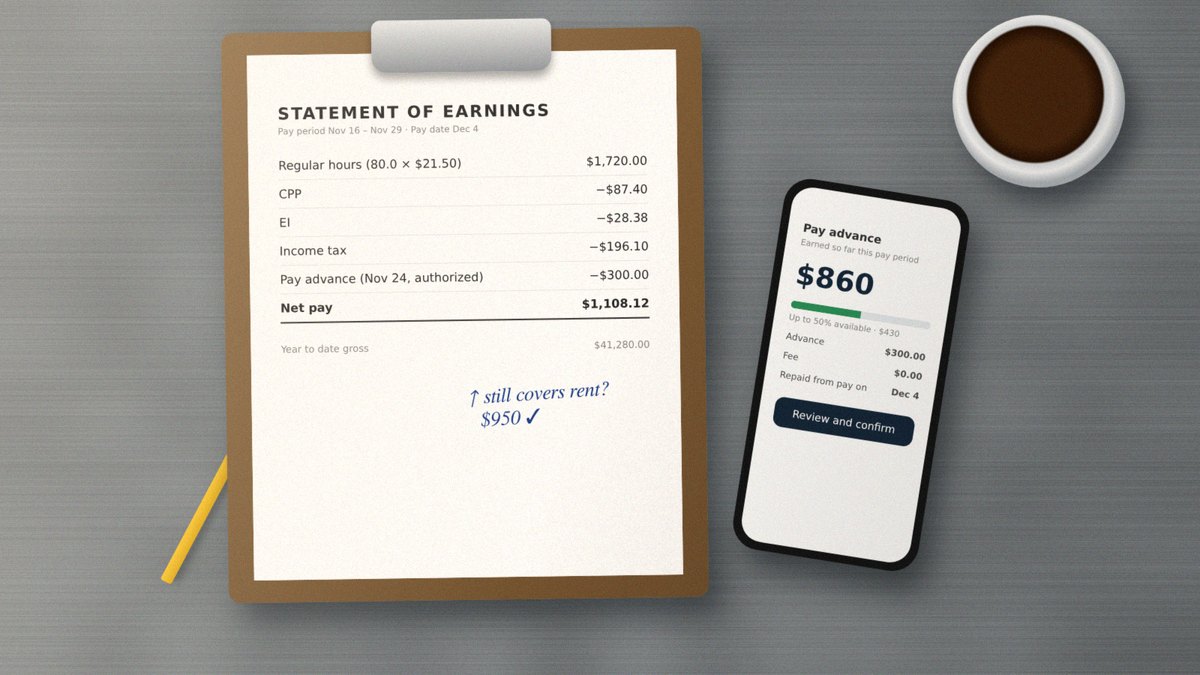
“Salary cash advance” sounds like one thing. In Canada it can mean five quite different arrangements: a favour from your boss, a feature in your employer’s payroll app, a phone app that fronts you a couple of hundred dollars, an app that’s actually a licensed payday lender, or an ordinary payday loan. They can all put money in your account before payday. What they cost ranges from nothing to $42 on a $300 advance.
This guide goes through each option in the order most people should try them: cheapest and least risky first. It covers what each one costs, the rules that apply, and the one risk they all share.
The Short Answer
If your employer will advance part of your pay, that’s almost always the cheapest option. It’s often free and repaid automatically from your next paycheque. If not, earned wage access through your employer’s payroll provider and cash advance apps usually cost a few dollars for amounts of a few hundred dollars. A licensed payday loan costs up to $14 per $100 but can go up to $1,500 and doesn’t need your employer at all. Whatever you choose, remember that your next paycheque will be smaller by the amount you advanced.
Five Ways to Get Part of Your Pay Early
| Option | Who provides it | Typical amount | Typical cost |
|---|---|---|---|
| 1. Employer pay advance | Your employer directly | Often a portion of pay already earned | Usually free |
| 2. Earned wage access (EWA) | Your employer’s payroll partner | A share of wages already earned | A small flat fee per advance, sometimes paid by the employer |
| 3. Cash advance app | An independent app linked to your bank account | Roughly $250 to $750 depending on the app | Subscription, express-delivery fee or optional tip |
| 4. “Pay advance” app that’s a payday lender | A licensed payday lender under an app brand | Up to $1,500 | Up to $14 per $100 |
| 5. Payday loan | A licensed payday lender | Up to $1,500 | Up to $14 per $100 |
1. Ask Your Employer for a Pay Advance
Plenty of employers will advance pay if asked, especially smaller businesses and workplaces where you’ve been for a while. It’s rarely advertised. Most people never ask because it feels awkward. In practice it’s a routine payroll request, much like changing your direct deposit.
To make it easy for your manager or payroll person to say yes:
- Ask for a specific amount that’s clearly less than what you’ve already earned this pay period.
- Suggest how it’s repaid: usually deducted in full from your next paycheque, or split over two if that’s more realistic.
- Put it in writing. A short email setting out the amount and the repayment protects both of you.
The writing matters for legal reasons too. In Ontario, the Employment Standards Act lets an employer take money from your wages only in limited cases. One of them is a written authorization from you that states the amount to be deducted. A spoken agreement or a vague clause in your contract isn’t enough. Other provinces have similar rules in their employment standards laws, so a clear written note setting out the advance and the repayment is the safe approach anywhere in Canada.
2. Earned Wage Access Through Your Employer
Earned wage access, or EWA, is the app version of an employer advance. Your employer connects a provider to its payroll. You can then draw part of the wages you’ve earned so far, and the amount comes off your next paycheque automatically. Calgary-based ZayZoon is one of the better-known Canadian examples. It charges a small fee for each advance, recovers the money from your paycheque through the payroll connection, and some employers cover the fee themselves as a benefit.
Two things to know. First, it only works if your employer has signed up, so ask HR or check your payroll app. Second, Canada has no law written specifically for earned wage access. Employment lawyers have pointed out that it isn’t directly regulated here yet. Providers treat it as early payment of your own wages, not as credit, which is why it’s usually limited to pay you’ve already earned.
3. Cash Advance Apps
Cash advance apps don’t involve your employer. You link your bank account, the app looks at your deposit history, and it offers a small advance that it takes back automatically when your next pay lands. Apps such as Bree, KOHO Cover and Nyble advance a few hundred dollars, with limits from about $250 to $750 depending on the app. New users usually start lower.
They’re often advertised as interest-free, and many are. But they make money in other ways, so look at how you’d actually pay:
- Express fees. The free option can take a few business days. Getting the money in minutes usually costs extra.
- Subscriptions. Some apps charge a monthly fee, and it keeps billing in months you don’t borrow anything.
- Tips. An “optional” tip screen is still a cost if you leave the default amount.
Before signing up, check what happens if the repayment fails because your pay is late or smaller than expected. The app will attempt the withdrawal, and a failed attempt can bring a bank NSF fee even if the app itself doesn’t charge a late fee.
4. When a “Pay Advance” App Is Really a Payday Loan
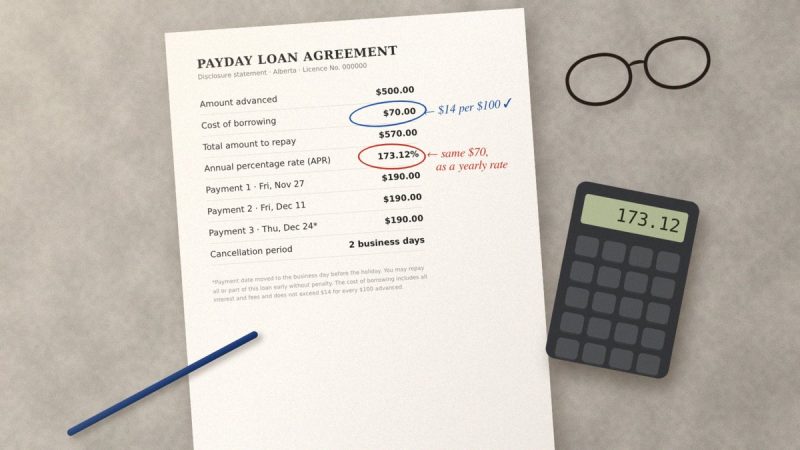
Some apps market themselves as pay advances or salary advances but are licensed payday lenders. One such app holds payday loan licences in BC, Ontario and Alberta and discloses its cost as $14 per $100, or $70 on $500 over 14 days. That isn’t wrong. A licensed payday loan is legal and regulated. But it costs far more than an employer advance or a fee-free app, and you should know which one you’re getting.
The giveaway is in the paperwork. A licensed payday lender has to show you a licence number for your province, the total cost in dollars and the APR before you sign. If you see those, you’re looking at a payday loan with an app attached. Our guide to payday lenders explains how to check a lender’s licence in your province.
5. A Payday Loan
A payday loan is the most expensive way to get money before payday, and sometimes it’s the only one that works. That’s usually when your employer doesn’t offer advances, the apps cap you below what you need, or you need more than a few hundred dollars. Licensed lenders can lend up to $1,500, repaid within 62 days, and the cost is capped at $14 for every $100 borrowed, all fees included.
If you go this way, use a lender licensed in your province, borrow only what your next paycheque or two can cover, and make sure each repayment date falls after your pay lands. Our online payday loans guide covers how they work and what to check before you sign. Our e-Transfer loans page explains how the money is sent.
What a $300 Advance Costs Each Way
Here’s the same $300, taken ten days before payday, done five ways. The fees below are examples to show the scale. Your employer’s or app’s actual fees will vary.
| $300, repaid in 10 days | Example cost | As an APR |
|---|---|---|
| Employer pay advance | $0 | 0% |
| EWA with a flat $5 fee | $5 | About 61% |
| Cash advance app, free standard delivery | $0 (if you can wait a few days) | 0% |
| Cash advance app with an $8 monthly plan | $8 (more if you keep the plan) | About 97% |
| Licensed payday loan at the maximum | $42 | About 511% |
Two things stand out. Even a $5 fee works out to a big APR over ten days, so don’t take a small advance more often than you need to. And a payday loan costs roughly eight times as much as a typical EWA fee for the same $300. If either of the first two options is open to you, use it. For more on why short-term APRs look so high, see our payday loan interest rate guide.
The Risk Every Salary Advance Shares
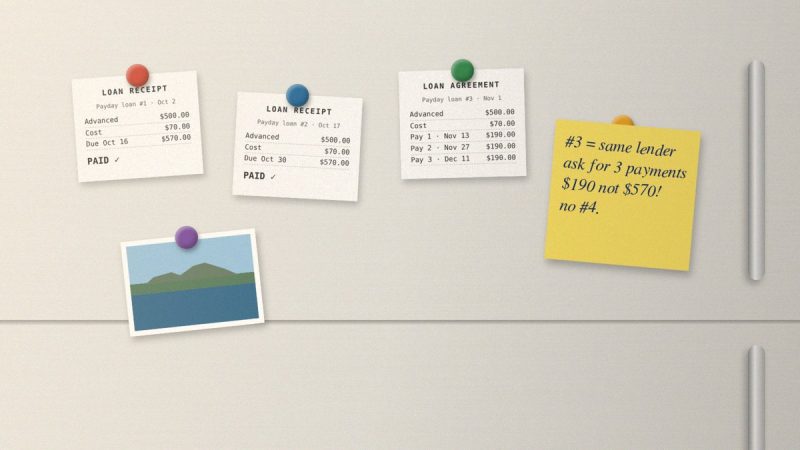
Every option on this list, including the free ones, does the same thing: it moves money from your next paycheque to this one. If the shortfall was a one-off, like a car repair or a vet bill, that’s fine. If it happens every month, the advance just pushes the gap two weeks along, and each paycheque arrives a little smaller than the last.
A simple test before you advance anything: after the advance comes off, will your next paycheque still cover rent, food and bills? If not, a smaller advance or a different plan is safer. If you’re advancing pay most pay periods, a free non-profit credit counsellor can help you find where the gap comes from. Our list of payday loan alternatives covers other ways to bridge a short month, and our short-term loans guide compares every kind of short-term credit in Canada.
Before You Take a Salary Advance: A Quick Checklist
- Have I asked my employer, or checked whether my payroll app offers earned wage access?
- Do I know the total cost in dollars, including express fees, subscriptions and tips?
- Is the provider a licensed payday lender? If so, have I checked its licence and seen the APR?
- When exactly will the money be taken back, and will my pay be in my account by then?
- After it comes off, can my next paycheque still cover my essentials?
Frequently Asked Questions
Is a salary advance a loan in Canada?
It depends on who provides it. An advance from your employer, or earned wage access through your employer’s payroll, is generally treated as early payment of wages you’ve already earned. Cash advance apps and payday lenders are lending you money against your future pay. Licensed payday loans are regulated as loans, with a cost cap of $14 per $100.
Can my employer refuse to give me a pay advance?
Yes. Employers in Canada aren’t required to offer pay advances. Many will if you ask, especially for a modest amount you’ve already earned, but it’s their decision.
Can my employer deduct an advance from my next paycheque?
Yes, if you agree in writing. In Ontario, for example, an employer can deduct from your wages with your written authorization stating the amount. A verbal agreement or a general clause in your contract isn’t enough. Check your own province’s employment standards rules for the details.
Are cash advance apps legal in Canada?
Yes. They operate legally, but earned wage access and fee-free advances aren’t covered by a specific Canadian law yet. Apps that charge payday-loan-style costs need a payday loan licence in your province. Always read how fees work and what happens if a repayment fails.
Does a salary advance affect my credit score?
An employer advance or earned wage access usually doesn’t involve the credit bureaus at all. Some cash advance apps report to a credit bureau as a credit-building feature. Payday lenders usually don’t report on-time payments, but an unpaid debt sent to collections can appear on your credit report.
What if I need more than a cash advance app will give me?
Most apps stop at a few hundred dollars. For up to $1,500, a licensed payday loan is an option, though a costly one. For more than that, look at a personal loan or line of credit from a bank or credit union, which must cost less than 35% APR.
How We Researched This Guide
We reviewed the Government of Ontario’s Employment Standards Act guide on wage deductions, provincial payday loan rules, and the published terms and pricing of earned wage access and cash advance providers operating in Canada, in November 2026. App limits and fees change often, so treat the figures here as a guide and check the provider’s current terms. CCFD is a referral service for licensed payday lenders and is paid by lenders when we refer an application. That’s why we’ve said plainly that a payday loan should be your last option, not your first.
This article is general information, not legal, employment or financial advice.