When an unexpected bill lands a few days before payday, online payday loans in Canada can bridge the gap without a trip to a storefront. You apply from your phone, see the full cost before you agree to anything, and approved funds usually arrive by Interac e-Transfer. But a payday loan is also one of the most expensive ways to borrow, so it pays to understand exactly how it works before you apply.
This guide walks first-time borrowers through the whole process: what a payday loan is, what it costs, what lenders look at, what to check in your agreement, and when a payday loan makes sense in an emergency (and when it doesn’t).
A quick note on who we are: CCFD is a free referral and financial-information service, not a lender. When you apply through CCFD, your application goes to a licensed payday lender in your province, and that lender decides whether to approve you and sets the amount, cost and repayment dates.
What is an online payday loan?
An online payday loan is a small, short-term loan, usually between $100 and $1,500, that you apply for online instead of in person. If you’re approved and accept the offer, the lender sends the money to your bank account, typically by Interac e-Transfer, and collects repayment from the same account on the agreed date.
A payday loan in Canada is meant for a temporary cash-flow gap, such as a car repair, a utility bill or a prescription that can’t wait until your next deposit. It isn’t designed for ongoing expenses or long-term debt. By federal definition, a payday loan has a term of 62 days or less, and in many provinces it’s repaid in one payment on your next payday. Some provinces set different repayment rules (more on that below).
How much does a payday loan cost in Canada?
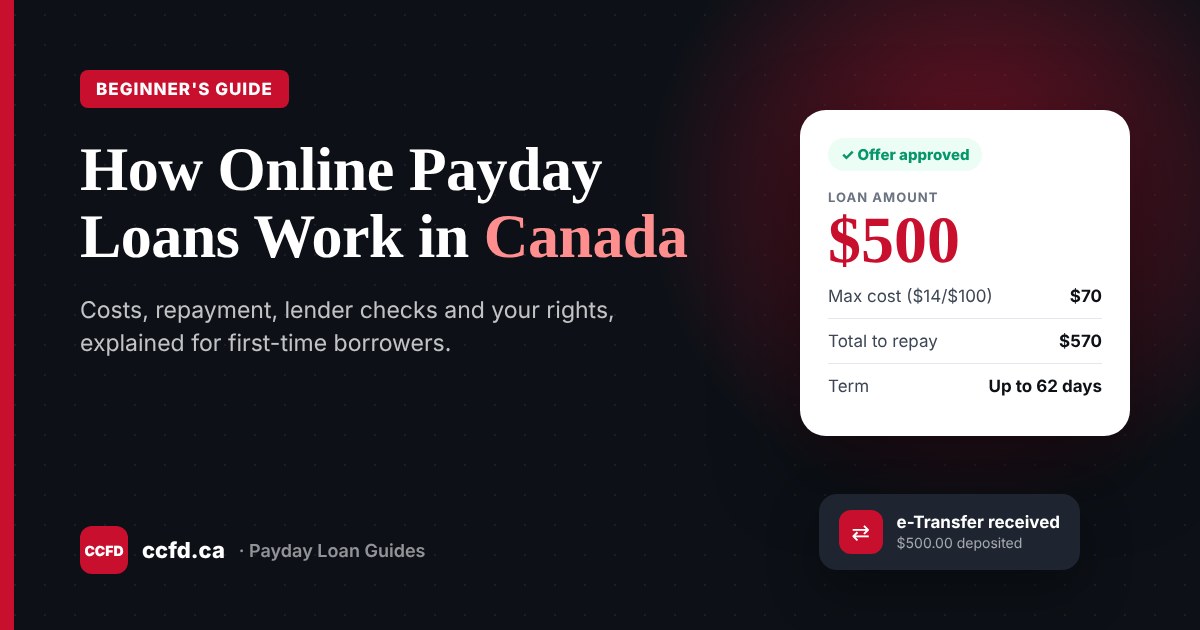
Since January 1, 2025, a licensed payday loan can cost no more than $14 for every $100 borrowed, including all fees. That limit applies in all nine provinces that license payday lending. Here’s what it means in dollars:
| You borrow | Maximum cost | Maximum you repay |
|---|---|---|
| $200 | $28 | $228 |
| $300 | $42 | $342 |
| $500 | $70 | $570 |
| $1,000 | $140 | $1,140 |
$14 sounds small, but it’s charged over a very short period. On a two-week loan, it works out to an annual percentage rate of roughly 365%, far more than a credit card or a bank line of credit. Your loan agreement must show the exact cost and rate before you sign. The simplest way to pay less is to borrow only what you need.
How online payday loans work, step by step
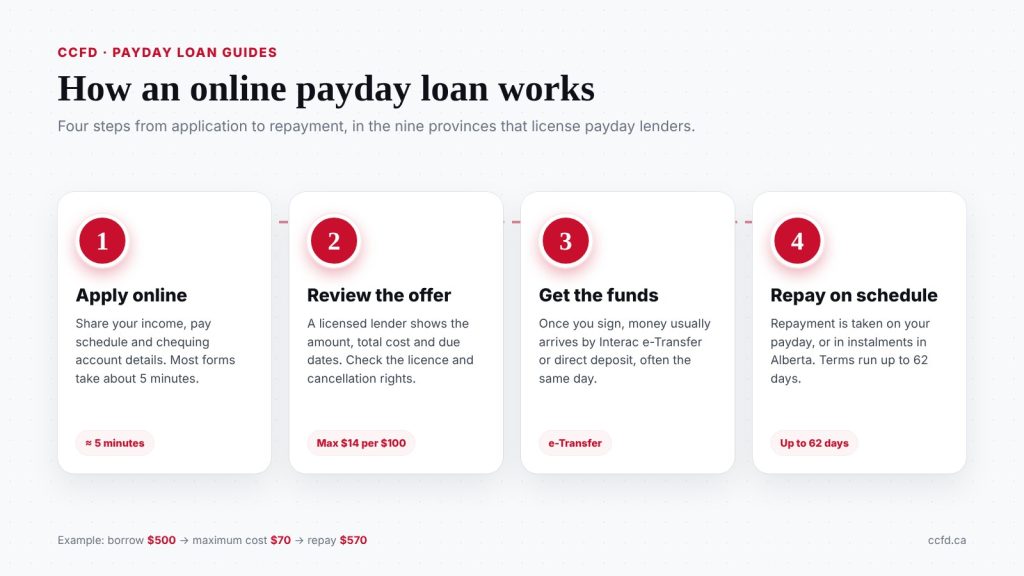
- Complete the online application. You share basic personal, income and banking details. The CCFD form takes about five minutes on any phone or computer, at any time of day.
- Get matched with a licensed lender. CCFD passes your application to a lender licensed in your province. Many lenders confirm your income through a secure, read-only connection to your bank instead of asking for faxed pay stubs.
- Review the offer carefully. Check the loan amount, the total cost of borrowing, every repayment date and any other terms.
- Accept only if it fits your budget. You’re never obliged to accept an offer, and applying through CCFD is free.
- Receive your money by e-Transfer. Once you sign, approved funds are usually sent by Interac e-Transfer, often within minutes, although a verification step or your bank can add time.
- Repay on the scheduled date. The lender withdraws each payment from your account on the agreed date. Make sure your pay has landed first, so the withdrawal doesn’t create a new shortfall.
What payday lenders look at
Payday lenders focus mainly on whether you can repay the loan from your next paycheque or deposit. Typical requirements are:
- You’ve reached the age of majority in your province (18 or 19, depending on where you live) and live in a province that licenses payday lending
- Regular income deposited to your bank account, such as wages, EI, CPP, a pension or disability benefits. Many lenders look for at least $1,000 a month.
- An active Canadian chequing account that accepts Interac e-Transfers
- A working phone number and email address
Some provinces also limit how much you can borrow compared with your pay. Ontario, British Columbia and Saskatchewan cap a payday loan at 50% of your net pay, and Manitoba at 30%. Lenders often approve a smaller amount on a first loan.
Can you get a payday loan with bad credit?
Often, yes. Because payday lenders look mainly at your current income and banking activity, a low credit score, collections or a past consumer proposal doesn’t automatically rule you out. That’s why people search for a “no credit check payday loan.” In practice, most payday lenders don’t rely on a traditional credit check, but some may still review your credit file, so ask the lender if it matters to you.
Approval is never guaranteed. Each licensed lender makes its own decision, and a legitimate lender will never ask you to pay a fee up front to get a loan.
What to check before you accept an offer
- Total repayment amount: exactly how much will come out of your account, and when.
- Cost of borrowing: it should never be more than $14 per $100 in a province that licenses payday loans.
- Repayment dates: each one should fall on or just after a pay deposit.
- Lender licence: the agreement must show the lender’s provincial licence number. You can confirm it with your provincial regulator.
- Cancellation rights: provinces give you a short cooling-off period after signing (two business days in Alberta, BC and Ontario) to cancel by returning the money, without paying the fee.
- Late-payment terms: what happens if a payment bounces, including any returned-payment fee and interest on the overdue amount.
Provincial rules matter
Payday lending is licensed in nine provinces, and each sets its own rules on loan size, repayment and cancellation. A few examples:
| Province | A rule worth knowing |
|---|---|
| Alberta | Payday loans are repaid in instalments over 42 to 62 days, not in one lump sum. |
| British Columbia | A loan can’t exceed 50% of your net pay during the loan term. |
| Ontario | A lender must offer an extended payment plan if you take a third loan within 63 days. |
| Manitoba | A loan can’t exceed 30% of your net pay. |
Payday loans aren’t available from licensed lenders in Quebec, where lending is capped at 35% a year, or in Yukon, the Northwest Territories and Nunavut, which don’t license payday lending. Whatever province you’re in, read your province’s guide before you borrow.
When a payday loan can make sense in an emergency
- You’re facing an urgent, one-time expense, like a car repair that gets you to work.
- You know exactly where the repayment is coming from.
- After repaying, you’ll still cover rent, groceries and bills until your next deposit.
- You’ve compared the cost with other options and nothing cheaper is available in time.
When to consider something else
- You can’t repay on the scheduled date.
- You need money for regular monthly costs, like rent every month.
- You already have one or more short-term loans.
- A cheaper option is available: a payment plan with the company you owe, an employer pay advance, an overdraft, or a small loan from your bank or credit union.
If you’re borrowing to repay other debts, a free non-profit credit counsellor can help you find a way out of the cycle. Our responsible borrowing guide explains where to start.
Frequently asked questions
Does CCFD lend money directly?
No. CCFD is a free referral and financial-information service. We send your application to a lender licensed in your province, and that lender approves the loan and sets its terms.
How fast can an e-Transfer payday loan arrive?
Many applicants get a decision within minutes. After you sign, approved funds are usually sent by Interac e-Transfer, often within about 15 minutes, although timing depends on the lender and your bank.
Will applying affect my credit score?
Payday lenders mainly assess your income and banking activity rather than your credit score, and most don’t rely on a traditional credit check. Some lenders may still review your credit file, so if this matters to you, ask the lender before you accept an offer.
Do I have to accept a loan offer?
No. Review the amount, cost and repayment dates, and decline if anything doesn’t work for you. Even after signing, you have a short cooling-off period to cancel.
What happens if I can’t repay on time?
Contact the lender before the due date. Depending on your province, the lender may charge interest on the overdue amount and a fee for a returned payment, and your bank may add its own NSF fee. Lenders can’t roll your loan into a new one to pay off the old one.
The bottom line
Online payday loans are fast, regulated and available to many Canadians with less-than-perfect credit, but they’re expensive. Used once, for a real emergency, with a clear plan to repay, a payday loan can bridge a short gap. Know the cost, borrow the smallest amount you need, check that your lender is licensed, and make sure every repayment date lines up with your pay.
Ready to see your options? Check if you qualify by applying online in about five minutes. It’s free, and there’s no obligation to accept an offer.